http://digiday.com/brands/calligraphy-culture-humor-recipe-pentel-pens-instagram-success/
Thank you, @tanyadua, for the excellent coverage. Proud of the team and collaboration with a great client.
http://digiday.com/brands/calligraphy-culture-humor-recipe-pentel-pens-instagram-success/
Thank you, @tanyadua, for the excellent coverage. Proud of the team and collaboration with a great client.
Disclosure: Mozilla is a partner of The Buddy Group. We proudly support certain internal product, communication and creative opportunities as needed. Proud to support the mission and ethos for which it stands.
Mozilla has changed. So have we, the user. One thing that has not changed however is the respect they show their users in everything they do.
Last year Mozilla embarked on the most unique, eye-brow raising, risk/reward endeavor I have ever seen a brand take. Not only were they going to re-brand Mozilla for the next generation of innovation but they were going to tackle it in a way only Mozilla could tackle– open, honest and ready for feedback. They opened the process to the community and through the process earned our respect for taking a road less (if not ever) traveled on this scale.
We, as a company, with all our spirit and gusto to be mavericks and push clients outside of their comfort zone, remained glued to our social streams waiting for what would be next.
What came out of it is fascinating, right and admirable.
Rather than recap every step myself, I turn it over to Adweek and Mozilla’s own voice which did a great job of keeping a running log of the process.
Enjoy and let me know what you think!
As written in ADWEEK: For the last six months, Mozilla has been working on a brand identity upgrade, and it’s kept a running log of this process. But it also took it one step further, releasing open-source guidelines for anyone who wanted to jump in and help compose a new logo and visual cues.
“Rather than conduct a brand refresh behind closed doors, we just thought maybe there’s a better or different way to do this,” Mozilla creative director Tim Murray said in August.
BREAKING— I have returned from CES 2017 without a cold! Each year CES typically leaves its attendees with a version of the funk that typically takes you down upon returning home. Here is to a healthy, funk free, 2017!
This year marks my 16th year attending CES, the default event for those who create, sell and market the technology in our personal lives. Each year I write up a post on the best things I have seen. This year, I am going to shake it up because times, they are changing…
Over the last decade, I have made it a point to drive to Vegas for the event. It proves to be a great plan as the meeting rooms, dinners and meet-ups tend to be spread out in multiple hotels or restaurants. It also serves as a great tool for reflection as the 4-5 hours is often plagued with poor cell service and true quiet time.
So, on my drive home I asked the question (to myself)…
Where is it all going?
To best answer this, I thought about the evolution of the CE (Consumer Electronics) industry over the last 17 years.
Since 2010, CES has been mostly about displays, plastic, hard drives and processors. From ultra flat monitors to tablets, innovation was best observed in the physical products on the floor. Booths were constructed with items spinning under spotlight and demonstrations meant people picked them up or watched their 4k brilliance.
If you follow the trades (and mainstream media) you heard that Amazon stole the show this year with Alexa. You also likely heard people say that they didn’t see anything that wowed them. Well, both are correct. However, I think this is not the full story…
The next 5 years or so will feel like nobody is innovating because innovation has always been measured in physical product. More and more “things” are being connected and as a result, the physical is becoming software enabled. As things become connected, it will be hard for them to be MORE connected. Thus, the innovation we are going to see and need to be better at managing will be in the ability for companies to understand customer needs and create a personalized experience IN or AROUND the products for which they produce. This will appear more as incremental innovation to outsiders but it truly is the holy grail of innovation.
We are in for an era of innovation where consumers buy and recommend based on a product or services ability to “fit them” or “adapt to their needs”. How and where they find out that these features fit them is more important that going to see a product on a shelf at Best Buy. These experiences will carry the innovation banner forward for the years to come.- my 2017 prediction
I saw this first hand this year in several instances. Most impressive was the demonstration of Comcast’s Xfinity network customer experience. The super smart, customer focused team at Comcast welcomed me into their suite at Venetian and offered a tour of what will be rolling out to all their customers in just a few months. Sure there was a box on table but the presentation was nearly 100% about the experience and the ability for the customer to control what mattered to them most. For example, Xfinity customers will soon be able to create profiles for their family members on their network allowing them to monitor, report and establish boundaries. This is great for families with kids who have personal devices but also the avid streamer who may be looking for better performance in their streaming.


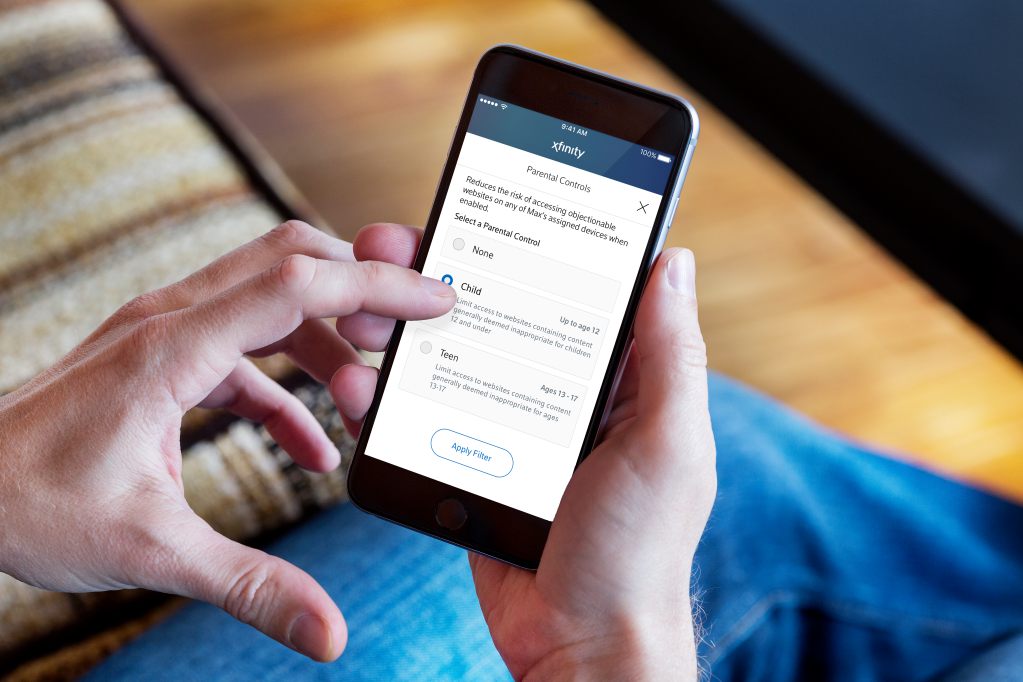
They have streamlined the onboarding process too, demonstrating that innovation doesn’t have to be wrapped in hard plastic. The new experience will be automatically enabled in the first half of 2017 for the approximately 10 million existing Xfinity Internet customers who have a compatible Xfinity Wireless Gateway. That number is expected to grow to more than 15 million by the end of the year as Comcast’s new Advanced Wireless Gateway becomes available to customers. This Advanced Gateway is capable of delivering up to nine gigabits per second over Wi-Fi within the home, supports voice, home monitoring and automation applications and will be the device Comcast uses to make one gigabit per second Internet speeds available across its entire service area.
My hat is tipped to the Comcast team for the fortitude and courage to show up at CES with commitment to the customer experience. Your investment there will win over those markets where you compete against outdated providers. Now, if only you offered your services in Orange County, California!
The number of connected devices is expected to rise from 10 to 50 devices by 2020. However, we are in for a period of time where “The Bigs” and “Start-Ups” alike will compete for your spare change via features that enable a more relevant, useful and personalized experience rather than push more product. Sure we will see people replacing physical items (Dishwashers, Cars, Toasters, etc.) with a new connected version but the idea that we will have tons of new devices in our home in addition to currently non-connected devices is likely a fallacy with the exception of companies like SEVEN HUGS.
Stop looking for the new plastic on the shelf and start looking for the features that make it all “work for you”.
Personalization is going to change consumer expectations, security, user interface design and content delivery. As it pertains to the working world, Intel’s Brian McCarson calls this- Phase Two of the Internet of Things. The use of data to create a more optimized, personalized and relevant experience.
One size fits all will never work again- thankfully. We are in for an era will brands and manufacturers are going to be looking to consumers to help shape (real-time) the features, functions and experience with preference, data and feedback.
I am excited for a great 2017 filled with innovation, personalization and better customer experiences.
Pete
It’s an era of digital transformation, and 2017 will only see digital impact on marketing and advertising accelerate. In this climate, the most effective advertising agencies stay one step ahead of the trends that are affecting their clients. Here are the 9 B2B marketing trends that will be transforming the industry — and wreaking some havoc — in the coming year.
The best brands don’t focus only on generating leads, nor do they focus only on building brand; they do both, and they do so with a 60:40 ratio in favor of brand. If buyers don’t know and trust your brand, you won’t make it into their consideration set, and they won’t become leads.
The products and services that people buy in B2B are more expensive and impact many people in the organization. Because of this fact, B2B purchases are inherently risky and expensive emotionally. That means that buyers want to buy more a thought leader who helps reduce risk in the buying and implementation process. So what actually sells is thought leadership, not products and services. What sells is the emotional power of risk reduction. The strength of old maxim that nobody ever got fired for buying IBM is more potent than ever.
Businesses struggle to produce always-on marketing that maintains focus on key business topics and connects content and business strategy. By studying B2C Content Franchises such as “Star Wars” or “Batman,” B2B Marketers can understand why investing continuously and aggressively in your own content brand produces consistent results over time. At LinkedIn Marketing Solutions, for example, our own “Sophisticated Marketer” guides, podcasts, and videos have driven value for four years. As Michael Brenner, CEO of Marketing Inside Group, says, a committed investment in quality content marketing will deliver increasing value over time just like a 401K
Every employee interaction with the public is a branding and thought leadership opportunity. LinkedIn data shows that professional networks of an organization’s employees are, collectively, 10X bigger than the reach of the organization’s LinkedIn Company Page. Additionally, employee shared content gets 10X the engagement that an organization’s post does. By unlocking the hidden power of employee advocacy, organizations can potentially generate 100X today’s results.
People want to work, meet, and learn from the thought leader in a space. However, traditional metrics, such as CPCs and CPMs, do not reflect this. Organizations need to move beyond traditional metrics and embrace the new metrics that matter. And what metrics matter? Short-term metrics do not matter as much as these three long-term metrics that build your business for the future (and drive revenue):
When you hyper-target, you don’t save money. What you do when you hyper-target is ignore potential buyers and hidden members of the buying committee and other influencers. Smart marketers are now realizing that what was previously considered digital media “waste” is not waste at all. In fact, reaching a broader audience of potential influencers (from the C-suite to the factory floor) helps build brand, thought leadership, and ultimately preference. Instead of hyper-targeting, marketers, particularly in B2B, should be optimizing for reach.
Marketing on the Internet today means that you’re competing for the attention of your buyer with everyone else online — other companies, the buyer’s friends and relatives, celebrities, the press (fake and otherwise). It has never been more difficult to break through. By recognizing the concept of the 80/20 rule, marketers know 80 percent of their results are driven by 20 percent of their content. Marketers must identify the 20 percent of their content that is driving results and put budget behind that content to amplify it via paid digital and social advertising.
CPG marketers understand the importance of maintaining the same brand identity in the offline world to build brand recall. Look at Coca-Cola: From the bottle to the website to the TV spots, the company uses the same red and white color scheme, the same font, and consistently talks about “happiness.” Then why do online marketers – in B2B and even B2C and certainly lacking the budget of a Coca-Cola – not practice the same disciplined “touchpoint consistency” to build brand recall?
Marketers (and ad agencies) tend to be reasonably effective at building the brand they present to customers and prospects. They are less effective at building their talent brand, which is the brand they present to employees and prospective hires. In this fast changing, digital world, having skilled, resourceful talent is more important than ever. A strong talent brand pays dividends in limiting turnover, reducing the cost per new hire, and boosting the number of applicants to job posts on LinkedIn
A flood of connected home appliances is on the way.
There has been a limited number of new products and market movement recently, but that is about to change, based on a new study.
The number of connected home appliance shipments will hit 202 million units globally by 2021, up substantially from 17 million this year, according to the Smarter Kitchen, Smarter Shopping study by Juniper Research.
Smart appliances will be dominated by large vendors, unlike the smart home ecosystem that was developed by small startups, according to Juniper.
FOR IMMEDIATE RELEASE
OCTANE OC, MACKENZIE CORP., TEN-X, AND THE BUDDY GROUP JOIN FORCES TO PRESENT THE 4TH ANNUAL BUDDY GROUP INVITATIONAL
Featuring a Unique Performance by Flock of 80’s
ORANGE COUNTY, CA — OCTOBER 5, 2016 —The Buddy Group, Inc. and Project Hope Alliance, a 501(c)(3) non-profit organization dedicated to ending the cycle of homelessness for kids in Orange County, today announced details for the Fourth Annual Buddy Group Invitational to be held on Monday, November 7, at the Aliso Viejo Country Club in Aliso Viejo, California.
From wacky argyle socks to rock music blasting the greens, The Buddy Group Invitational is one of the most unique and fastest growing un-golf golf events in Orange County. For the first time, this year’s event will be capped off with an outdoor concert under the stars by Orange County’s most beloved band, Flock of 80’s.
The format for the Invitational is a four-player best-ball with unique activities and challenges peppered across the 18-hole course. Following the tournament, players, sponsors and non-golfing invited guests will partake in a special 80’s-themed party hosted by the presenting partners and the generous sponsors (see below), as well as silent auction donors. Flock of 80’s will perform at sunset to cap off the night. While the golf event and concert are invite only, interested parties can request more information via the website. But just like past years, this event will sell out.
“Our events bring together brand builders, investors, inventors, and entrepreneurs who seek to Be The Exception(™) in their respective fields,” said Pete Deutschman, CEO of The Buddy Group. “By uniting our employees, clients, and partners, we will once again come together to raise awareness and funds to help Project Hope Alliance end the cycle of homelessness in Orange County. Project Hope Alliance is an amazing non-profit organization with an entrepreneurial spirit that authentically speaks to our guests and sponsors.”
“This is hands down one of our favorite events of the year,” said Jenny Dinnen of MacKenzie Corporation. “We always talk about wanting to work with industries and companies that we are passionate about. I would be hard pressed to find two more passionate leaders than Pete and Jennifer for moving their companies/organizations forward. We are proud to be sponsors again and look forward to this amazing event.”
“We’re proud to support The Buddy Group and Project Hope Alliance in their mission to end youth homelessness in Orange County, a community where our company has very deep roots,” said Ten-X CEO Tim Morse. “Ten-X is committed to investing in America’s youth and to helping preserve the American Dream, and there’s no better place to start making an impact than in our own backyard.”
“There are more than 26,000 homeless kids in Orange County,” said Jennifer Friend, CEO of Project Hope Alliance. “It is inspiring to see leaders of business, marketing, and technology come together on behalf of such an important cause.”
For more information about the tournament, including online registration and donations, visit invitational.thebuddygroup.com.
The Buddy Group Invitational 2016 Partners include:
Presenting Partners: The Buddy Group, OCTANe OC, MacKenzie Corporation and TEN-X.
Sponsors: Google, Signature Analytics, Top-End Motorwerks, Adorn Premiums, Pentel of America, Prosum, SpaGirl Cocktails, LootCrate and Lynx Grills.
###
About The Buddy Group
The Buddy Group is evolving what it means to be an agency by focusing on the experience of an ever-evolving connected consumer. Driven by forethought, The Buddy Group shapes how audiences or segments think about brands and products by creating for the future. The Buddy Group offers strategic research, user-experience planning, and award-winning creative and development execution services to brands including Dell, Zodiac Aerospace, Edwards Lifesciences, Stacked, Ladera Ranch, Mozilla, and Pentel of America. Founded in 2005, The Buddy Group’s team of experts are located in Irvine, California, where they leverage their in-house experiential and content soundstages — DotLot™. For more information, visit thebuddygroup.com.
About Octane
OCTANe drives technology industry growth and innovation in Orange County by connecting ideas and people with resources and capital. Its members represent Orange County technology executive leaders, entrepreneurs, investors, venture capitalists, academicians, and strategic advisors, all working together to fuel innovation in the OC. The organization has helped more than 800 companies via the LaunchPad™ SBDC accelerator. LaunchPad™-certified companies have received more than $1.7 billion in investment and equity exits. OCTANe annually welcomes more than 7,000 people to its programs and events. More than 2,000 business leaders throughout the Orange County region are OCTANe members. For more information, visit www.octaneoc.org.
About Ten-X
Ten-X is the nation’s leading online real estate transaction marketplace and the parent to Ten-X Homes, Ten-X Commercial, and Auction.com. To date, the company has sold 244,000+ residential and commercial properties totaling more than $41 billion. Leveraging desktop and mobile technology, Ten-X allows people to safely and easily complete real estate transactions online. Ten-X is headquartered in Irvine and Silicon Valley, California, and has offices in key markets nationwide. Investors in the company include Google Capital and Stone Point Capital. For more information, visit Ten-X.com.
About MacKenzie Corporation
MacKenzie Corp. is a family-run firm with over 30 years of experience in partnering with clients to make them stronger and more profitable by strategically and creatively using data analytics and research. Success is achieved by uncovering detailed stories within data sets, making analytic results palatable, relevant, and useful to decision makers. At our core we are Curious, Creative, and Customer-Centric in our approach to all matters. Curiosity drives us to ask questions others do not. Creativity reveals trends, opportunities, and threats that others do not see. In being customer-centric, we always put the customer first because we truly care about their success. The only way we achieve success is through the success of our partners. For more information, visit www.mackenziecorp.com
About Project Hope Alliance
Founded in 1989, Project Hope Alliance is ending the cycle of homelessness in Orange County, one child at a time. The nonprofit organization supports homeless students and their families, meeting the unique academic and psychosocial needs of these children via a two-generational approach targeting innovative rapid rehousing and education programs. Since 2012, Project Hope Alliance’s Family Stability Program has worked with over 150 families to end homelessness by moving more than 700 parents and children into permanent housing with financial independence. Project Hope Alliance is located at 1954 Placentia Avenue, Suite 202, Costa Mesa, CA 92627. For more information, contact Suzy Gardner at suzy@projecthopealliance.org or 949-791-2714, or visit www.projecthopealliance.org.
So, I have been thinking about change…a lot.
As I look back over the last 11 years (since The Buddy Group’s inception) it has been our team’s ability to evolve and force change that has provided some of our greatest fuel for growth.
This week I will be speaking to a group of business leaders and fellow CEOs about a point of view we (at The Buddy Group) have had for a while.
The premise of the topic is simple for entrepreneurs to grasp as most entrepreneurs are by their very nature mavericks and risk-takers,looking to disrupt static industries or blaze trails to create categories fertile for monetization. Despite the inherent understanding of the importance of change, for most change is often difficult to define and implement.
Why?
Because change can be very scary! I am attracted and invest in business leaders, inventors and creators who face the fear head-on and embrace change.
Change is a stance that’s ingrained into our own business and company culture at The Buddy Group, so much so that it anchors our own mission statement.
The Buddy Group is evolving what it means to be an Agency
– The Buddy Group’s Mission Statement
The agency model is broken, retainers are rarely mutually beneficial and client perception of agency value is at best, strained. At the same time, today’s consumer (user) behavior changes, often overnight. We are seeking to disrupt the agency model, build long-term relationships powered by success and in-turn, change the way clients perceive working with an agency. Evolving an agency requires several things, most importantly being bold and helping others to do the same.
Being bold in business today means understanding your audience’s needs and behaviors in real-time. It means creating a culture at your company where informed change- leveraging data and evolving customer expectations- forces frequent change.
So how exactly should a brand BE bold? It starts with being true to who you are. We have all been at those parties where someone in the room is trying too hard to be something that they are not. Sure there are a few people in the room who fall for it, but generally speaking people can sniff out the bull-shit.
#1 Be authentic
Bold is forward thinking, bold is imaginative, and bold is brave. That is…until it’s not. Marketers must be careful, because bold can very easily lose its courage and daring.
How? By losing its authenticity. There is a fine line between authentic (connecting with the audience) and being inauthentic (being self-centered and turning them off).
Be authentic by being aware of your audience. Develop the storyline of your brand according to your audience and always have their needs in mind. Consumers expect this more than ever.
#2 Have change happen because of you, rather than to you
Change is happening in your business right now. Are you calling it out and embracing it? More so, what may work now may not work six months from now, simply because technology and consumer behavior change faster than ever before.
As business leaders, we must feed off that change, adapt accordingly, and evolve just as quickly, in order to create something that has a lasting impact and stays relevant. This does not mean implementing change just for the sake of changing.
Make change happen because of you. When you make an emotional connection with your audience, it then leads to a change of behavior. Base change on information garnered by data.
#3 Know what to do with (big) data
Big data is a large volume of information that can be analyzed to reveal trends and patterns in how consumers interact and behave.
The people of today’s world (both consumers and marketers alike) are in a new era where data simply floods them. With desktop computers and personal mobile devices at their fingertips, consumers are able to access more information than ever before, and at a faster rate than ever before.
Marketers meanwhile, are able to see how consumers interact with this information. With this influx of data volume, it is easy to assume that marketers have everything they need to pinpoint exactly what consumers are looking for.
Not true.
The volume or amount of data in itself is not useful. Big data, no matter how vast in volume, will be just a useless pile of information sitting on a hard drive if you do not correctly leverage it.
The real worth of big data is knowing what to do with that data when it arrives on your desk. You must know how to extract the information and then turn that into solid strategy and decisive planning. Big data simply informs us, but it is what you do with that information that is the true key to success.
So what do we do with that data exactly? We use it to focus on the personalization of the brand.
#4 Place importance in the personalization of brand messaging
No matter if you are building a B2B brand working with channel partners or a consumer focused consumer packaged goods company, we must understand that brands are not one-size-fits-all. There are many levels of personalization, and brands need to understand their specific truth to know where they fall in that spectrum.
With brand personalization, it is important to note that there is a fine line between normal personalization and creepy personalization. Creepy is characterized by personalization that feels forced, inauthentic, and too…well…creepy. Despite the ability, Starbucks doesn’t give you mobile alerts telling you that you have a full day of meetings ahead and suggesting you to grab a shot of espresso. Starbucks would rather make the process of ordering more efficient and create a great customer experience than leverage creepy means of marketing to their valued customers.
The creepy side of personalization has spawned huge backlash in digital advertising with ad blockers, yet another reason why the agency model has to change…dramatically.
Personalization of brand needs to be welcomed by the user and of value to them. This can be done by having created a connection between the consumer and the brand, rather than using impersonal marketing techniques. Build your business on relationships and focus your brand’s messaging AND your product around the features and benefits that speak to each segment. As we have learned from our client, Mozilla – always respect the consumer. In return, they will be loyal to you as a result.
#5 Form a mutual story with your audience
In the 80s a movie debuted that would end up becoming a childhood classic. It told the story of a schoolboy, who becomes engaged in a story and he begins to see himself in the story as it unfolds . That book was called The Never-Ending Story. Some people loved that weird looking flying dog and others thought it was freaky and gave them the heebie-jeebies.
What is important is that his feelings about the journey and the characters start manifesting in the book. His desires, his dislikes, his fears, and his insecurities affect the outcome of the story. That book’s story becomes part of his story.
Think about that: As businesses begin to get data back from interactions at retail, sales calls or website engagement, the brand begins to provide value and personalize the story and evolve chapter over chapter. Through our individual experience with the brand, each of us develops our own unique journey. And the brand’s story begins to evolve according to that interaction.
We all have those brands that have already done this for us. These are brands that have become such a part of our everyday lives that they seem baked into our DNA. For some people, Apple has done this. And for others, Tesla has. Loyalists of Apple and Tesla will cheer for the success of its products and wholly defend these brands because they feel that the product, brand, and experience was crafted with them in mind. They feel that these brands truly respect their time and appreciate their business models.
#6 Prioritize the experience of the customer
There is a distinct difference between customer experience and the experience of the customer. Customer experience is atmospheric and generalized (one size fits all). Meanwhile, the experience of the customer is more related to how well a brand personalizes experiences for their audience, authentically leveraging technology in a more 1 to 1 manner.
For example: Potential clients who are looking for business-to-business partnerships are doing their research on personal devices, on personal time. They are using mobile phones at home on the weekends to research potential business partners. Afterall, businesses are still run by people, and decisions are still made by people.
Catering to mobile devices over desktop devices personalizes that experience for that customer. A prospect is welcoming you into their home, on to their sofa to engage in a conversation around a potential deal; you better respect them and give them an experience that gives them exactly what they are looking for as quickly as possible without much looking.
In the past, marketers may have only had to worry about developing a brand for one customer persona. But in this day and age, there may be five or more different customer personas per product or service. And for each of those personas, their behaviors could and will change.
In that case, marketers must create a framework to understand those behaviors, the tools they use, and the platforms they are on, then adjust with how rapidly all those factors change. Marketers must ask themselves, “What are the personas that matter most, and what is the ideal customer journey based on that?”
#7 Stay bold- Continue to evolve
So what happens when you nail it?
Others are going to follow and begin to look and sound very familiar to you. Another great reason to embrace change and continue to evolve.

We welcome an opportunity to chat with you and discuss how we can drive informed change and help you “Be The Exception” in your vertical or segment. Contact me at pete@thebuddygroup.com or connect with me on LinkedIn @ https://www.linkedin.com/in/petedeutschman
CONSUMER-GENERATED CONTENT HELPS DRIVE ONLINE SALES: Consumer-generated content (CGC) is on the rise as e-commerce continues to grow thanks to social media and product review sites. Shoppers are able to more readily spread the word of their favorite brands and products, and retailers are taking advantage to drive sales, according to a report from BazaarVoice.
Shoppers that interact with CGC are 97% more likely to convert with a retailer than customers who do not. Brands see a 78% lift in conversion rates when customers interact with CGC.
Revenue per visitor for retailers increases 106% when customers interact with CGC versus those that do not. For brands, revenue per visitor sees a 75% lift due to CGC.
Average order value among retailers gets a 10% lift when shoppers interact with CGC. For brands, AOV sees an 8% lift.
Taking advantage of the high volume of CGC is vital to retailers that want to win over potential shoppers and their trust. US consumers are heavily reliant on online reviews before making both in-store or online purchases, according to a separate report from Bazaarvoice cited by Internet Retailer. In addition to including shoppers’ social media posts in their own campaigns, brands and retailers can reprint positive feedback in brick-and-mortar locations, print advertisements, and other online ad campaigns to help drive sales.
54% of US shoppers read online reviews before making an e-commerce purchase.
39% of shoppers read online reviews before buying in-store.
82% of shoppers read reviews while inside a store immediately before making a purchase.
The most read reviews are for electronics, with 58% of shoppers performing research before buying anything in this product category in-store.
bii cgc on purchase journey
|
BREAKING DOWN OPERATIONAL EXPENSES FOR INDUSTRIAL IoT DEPLOYMENTS: Jasper, which provides a software platform for connecting and managing IoT devices and was recently acquired by Cisco, released a study this week breaking down operational expenses for industrial IoT deployments, and explaining how companies can save on those expenses. The cost of operating IoT devices can vary widely for enterprises depending on a multitude of factors including the type of devices, the type of internet connection it uses, and where it is deployed. This makes it difficult for enterprises to estimate the full cost of deploying IoT devices and their ROI on IoT initiatives. The study grouped operational expenses into three categories:
Companies can reduce these expenses with certain solutions and strategies. For example, if a company’s data usage for its IoT deployments fluctuates monthly, it can opt to pay its data subscription on a per megabyte basis instead of paying the same amount every month. The study also found large disparities in costs for devices depending on whether they were connected to a software services platform. The study estimated that administrative costs per 100,000 connected devices dropped from $2 million per year to $800,000 per year if they’re connected to a platform. Jasper is one of the major providers of such platforms, so the finding is certainly helpful for its business. However, if platform providers can provide such steep cost reductions for their enterprise clients, then it could be a major boon for enterprise IoT adoption. |

 Pete Deutschman
