I have watched Hang w/ Andrew and Dave (founders) patiently grow their user base to 2 mil. With the overnight attention to Meerkat it is nice to see a nod in their direction.
Category: Business
This is a REALLY big deal: Real Measurement of TV Ad Views | Adweek
Google is testing the ability to measure how many TVs actually showed an ad. Photo: Google Fiber
Want to know exactly how many people saw your ad on TV? Want dynamic insertion? The answer has long been “tough luck.” But now it’s possible … in Kansas City.
Adweek has learned that Google will be rolling out a TV ad-tracking system similar to the technology used to measure ad views online, giving the company a more accurate idea of how many people are watching the ad inventory it sells in Kansas City than traditional panel measurement ever could.
GENERATION Z SHOULD BE MORE OF A FOCUS FOR DIGITAL MARKETERS :
“Many of us think about millennials a lot, but this is the generation we’re actually preparing the path for,” said Victor Bayata, head of mobile solutions at Ikea, speaking at the New York Mobile Marketing Association forum yesterday. Generation Z, according to Bayata’s definition, spans anyone born in the years 1992 to 2010. That would seem to overlap with many common definitions of millennials (like Goldman Sach’s, which defines the millennial generation as anyone born between 1980 and 2000). However they’re defined, younger millennials and anyone born around the turn of the century are “digital native,” and trendsetters when it comes to digital behaviors.
Generation Z has already shown itself to be extremely web- and mobile-focused when it comes to shopping. Although this age group, given its youth, doesn’t have a great deal of spending power yet — earning an average $13,000 annually in income, in the US — it spends a significantly higher share of income online at 9% than any other age cohort (see chart, below, in which Generation Z is defined as anyone born between 1990 and 1996).
VIRTUAL REALITY AND BRANDS
DIGITAL MEDIA COMPANIES ARE EXPERIMENTING WITH VR: New virtual-reality software and content will fuel strong demand for virtual-reality devices. VR headset shipments will top 26 million by the end of 2020 (see chart, below). That represents a compound annual growth rate or CAGR of 99% between 2015 and 2020, according to BI Intelligence estimates.
Here’s a rundown of some of VR’s biggest announcements:
YouTube is paving the way for mainstream VR content distribution by adding support for 360-degree videos. Viewers can orient the direction of view as the camera moves through the scene. Playback is only supported on desktop (via Chrome) and on Android’s YouTube app at the moment, but it’s easy to imagine playback being extended to consumer VR headsets once these devices launch. Transmitting 360-degree video over the internet is quite challenging. 360-degree videos demand as much as five times the bandwidth of standard YouTube videos, Gizmodo points out, but YouTube’s expertise in video compression and delivery will go a long way to solve this problem.Screen Shot 2015 03 19 at 1.50.40 PM (2)
Google is developing a VR-device version of the Android operating system, the The Wall Street Journal reports. Just like Android for tablets and smartphones, Google will allow hardware VR-headset-makers to use the operating system for free. “Android VR” could serve as the foundation for a new class of VR games, applications, and content.
Facebook-owned Oculus debuted its first VR movie from its VR-film studio Story Studio at the Sundance Film Festival, according to the Guardian. The film demonstrates how filmmakers can use VR as a canvas for interactive movies.
VR was the standout trend at this years Mobile World Congress, as reported in our MWC highlights. Several hardware makers announced new VR headsets, including HTC and Samsung. Content producers touted VR as a major platform for media distribution. “The most exciting evolution in the content space is going to be VR,” 20th Century Fox Home Entertainment executive Brendan Handler said while speaking at the conference.
VRForecast
YouTube launches cards for linking viewers to other videos, playlists, merchandise, fundraising, and websites | VentureBeat | Media | by Emil Protalinski
At any other time during the video, viewers will see just the “i” icon appear when they hover over the player on desktop or whenever the player controls are showing on mobile. They can click or tap this icon to browse all of the cards included in the video.
When Will the Internet of Things Come of Age?
Will consumers take smart mowers with lawn data lying down?
Technologists are holding court at South by Southwest this weekend on the so-called Internet of Things, a future reality where data will be gathered and used for everything from cars and lawn mowers to refrigerators and toothbrushes. Many of these connected products are already available, but when will they become so ubiquitous that marketers must change course—as when smartphones became part of non-techies’ lives half a decade ago?
The truth of the matter is there’s still infrastructure work to be done. Telecoms and governments have to create digital avenues that would let all software-powered items talk to one another. And we need super-techie advances with microprocessors and batteries that will last for years. But South by Southwest goers generally agree with Samsung’s prediction that products will be routinely connected within the next five years.
“As microprocessors and bandwidth become greater and less expensive, converging with nanotechnology as wearables with sensors, the Internet of Things is already here but will gain exponential acceleration and become more utilitarian as we move into the future,” said Richard Hollis, CEO of digital commerce player Holonis. “That simply means that everything that is captured by these devices can used as purposeful information and meaningful data.”
OK, but will consumers buy enough “smart” products to make marketers rethink how their brands advertise in the coming years?
“There are a lot of smart appliances for the kitchen already, with more launching every day—just checking [digital fundraising platform] Kickstarter shows you where the industry is headed,” commented Kevin Yu, CEO of SideChef, a social-cooking mobile app.
Digital agencies are on board with the notion.
“In our own work, we’re focused on bringing digital and physical experiences together, and hiring a lot more designers with industrial design backgrounds to help us to that,” said Derek Fridman, group creative director at Huge. “We’re also creating dedicated workspaces in our offices in order to let us experiment with this kind of work.”
360i technologists Layne Harris and Fitz Maro recently wrote a thesis actually predicting big Internet of Things afoot this year, much less 2020. Here is one part of their rationalization: “In 2015, marketers can expect to see broad adoption of more affordable technologies that are inspiring consumers’ lives and lifestyles by offering seamless integration between the digital and physical worlds. The resulting evolution of consumer behavior will require brands across every category to be more digitally centric in how they develop their marketing and brand experiences.”
But let’s take the perspective of someone who often analyzes how digital meshes with everyday people.
Erica Dhawan, CEO of Cotential, has researched how marketers, grandmothers and even homeless people either are affected or can be impacted by an increasingly interactive world economy. She spoke at SXSW this morning, plugging her book: Get Big Things Done: The Power of Connectional Intelligence.
“I am not sure we’ll all be ready [in five years] to embrace the Internet of Things,” Dhawan told Adweek off stage. “But with the generational shift that we are experiencing in today’s world, there will be people that will be ready. And like any force or new capacity, there will be those that will struggle.”
She added, “Those who understand how to engage with these new tools and technologies—it will be like the printing press and the steam engine, where people will look to use them as a force for good.”
Let’s hope so.
http://www.adweek.com/news/technology/will-internet-things-come-age-5-years-163449
BREAKING: #YouTube now supports 360-degree videos
In this, the second inning of interactive video, YouTube may just be in the best position to own interactive non-linear storytelling. This inning will feature 360 video with meta data. The bottom of this inning will provide fuel for 360 layering of interactive elements and make way for dynamic content…finally!
http://www.theverge.com/2015/3/13/8203173/youtube-now-supports-360-degree-videos
Launching at SXSW:Make real food as desirable as junk food #sxsw #indiegogo #biteme
Support our campaign to change the way the we perceive healthy food by backing this camapign on indiegogo officially launching this week at SXSW. Many thanks to the influential chefs, nutritionists and fellow marketers for the support.
https://www.indiegogo.com/projects/make-real-food-as-desirable-as-junk-food
Internet of Things: Where Does the Data Go? | WIRED
THE INTERNET OF Things means different things to different people. To vendors, it’s the latest in a slew of large-scale trends to affect their enterprise customers, and the latest marketing bandwagon they have to consider. To enterprise organizations, it’s still a jumble of technical standards, conflicting opinions and big potential. For developers, it’s a big opportunity to put together the right mix of tools and technologies, and probably something they are already doing under another name. Understanding how these technologies work together on a technical level is becoming important, and will provide more opportunities to use software design as part of the overall business.
As Internet of Things projects go from concepts to reality, one of the biggest challenges is how the data created by devices will flow through the system. How many devices will be creating information? How will they send that information back? Will you be capturing that data in real time, or in batches? What role will analytics play in future?
These questions have to be asked in the design phase. From the organizations that I have spoken to, this preparation phase is essential to make sure you use the right tools from the start.
SENDING THE DATA
It is helpful to think about the data created by a device in three stages. Stage one is the initial creation, which takes place on the device, and then sent over the Internet. Stage two is how the central system collects and organizes that data. Stage three is the ongoing use of that data for the future.
For smart devices and sensors, each event can and will create data. This information can then be sent over the network back to the central application. At this point, one must decide which standard the data will be created in and how it will be sent over the network. For delivering this data back, MQTT, HTTP and CoAP are the most common standard protocols used. Each of these has its benefits and use cases.
HTTP provides a suitable method for providing data back and forth between devices and central systems. Originally developed for the client-server computing model, today it supports everyday web browsing through to more specialist services around Internet of Things devices too. While it meets the functionality requirements for sending data, HTTP includes a lot more data around the message in its headers. When you are working in low bandwidth conditions, this can make HTTP less suitable.
MQTT was developed as a protocol for machine-to-machine and Internet of Things deployments. It is based on a publish / subscribe model for delivering messages out from the device back to a central system that acts as a broker, where they can then be delivered back out to all of the other systems that will consume them. New devices or services can simply connect to the broker as they need messages. MQTT is lighter than HTTP in terms of message size, so it is more useful for implementations where bandwidth is a potential issue. However, it does not include encryption as standard so this has to be considered separately.
CoAP is another standard developed for low-power, low-bandwidth environments. Rather than being designed for a broker system like MQTT, CoAP is more aimed at one-to-one connections. It is designed to meet the requirements of REST design by providing a way to interface with HTTP, but still meet the demands of low-power devices and environments.
Each of these protocols support taking information or updates from the individual device and sending it over to a central location. However, where there is a greater opportunity is how that data is then stored and used in the future. There are two main concerns here: how the data is acted upon as it comes into the application, and how it is stored for future use.
STORING THE DATA
Across the Internet of Things, devices create data that is sent to the main application to be sent on, consumed and used. Depending on the device, the network and power consumption restraints, data can be sent in real time, or in batches at any time. However, the real value is derived from the order in which data points are created.
This time-series data has to be accurate for Internet of Things applications. If not, then it compromises the very aims of the applications themselves. Take telemetry data from vehicles. If the order of data is not completely aligned and accurate, then it points to potentially different results when analyzed. If a certain part starts to fail in particular conditions – for example, a temperature drop at the same time as a specific level of wear – then these conditions have to be accurately reflected in the data that is coming through, or it will lead to false results.
Time-series data can be created as events take place around the device and then sent. This use of real-time information provides a complete record for each device, as it happens. Alternatively, it can be collated as data is sent across in batches – the historical record of data will be there, it just isn’t available in real time. This is common with devices where battery life is a key requirement over the need for data to be delivered in real time. Either way, the fundamental requirement is that each transaction on each device is put in at the right time-stamp for sorting and alignment. If you are looking at doing this in real time with hundreds of thousands or potentially millions of devices, then write-speed at the database level is an essential consideration.
Each write has to be taken as it is received from the device itself and put into the database. For more traditional relational database technologies, this can be a limiting factor, as it is possible for write-requests to go beyond what the database was built for. When you have to have all the data from devices in order to create accurate and useful information, this potential loss can have a big impact. For the organizations that I have spoken to around Internet of Things projects, NoSQL platforms like Cassandra provide a better fit for their requirements.
Part of this is due to the sheer volume of writes that something like Cassandra is capable of; even with millions of devices that creating data all the time, the database is designed to ingest that much data as it is created. However, it is also due to how databases themselves are designed. Traditional databases have a primary-replica arrangement, where the lead database server will handle all the transactions and synchronously pass them along to other servers if required. This leads to problems in the event of an outage or server failure, as a new primary has to be put into place leading to a potential data loss.
For properly configured distributed database systems like Cassandra, there is no ‘primary’ server that is in charge; each node within a cluster can handle transactions as they come in, and the full record is maintained over time. Even if a server fails, or a node is removed due to loss of network connectivity, the rest of the cluster can continue to process data as it comes in. For time-series data, this is especially valuable as it means that there should be no loss of data in the list of transactions over time.
ANALYZING THE DATA
Once you have this store of time-series data, the next opportunity is to look for trends over time. Analyzing time-series data provides the opportunity to create more value for the owners of the devices involved, or carry out automated tasks based on a certain set of conditions being met. The typical example is the Internet-connected fridge that realizes it is out of milk; however, Internet of Things data is more valuable when linked to larger private or public benefits, and with more complex condition sets that have to be met. Traffic analysis, utility networks and use of power across real estate locations are all concerned with consuming data from multiple devices in order to spot trends and save money or time.
In this environment, it’s helpful to think about when the results of the analytics will be required: is there an immediate, near real-time need for analysis, or is this a historic requirement? The popularity of Apache Spark for analysis of big data and Spark streaming for in near real time has continued to grow, and when combined with the likes of Cassandra it can provide developers with the ability to process and analyze large, fast-moving data sets alongside each other.
However, this is not just about what is taking place right now. The value from time-series data can come over time just as well. As an example, i2O Water in the UK looks at information around water pressure, taken from devices that are embedded in water distribution networks around the world. This data has been gathered over two years and is stored in a Cassandra cluster. The company uses this information for its analytics and to alert customers around where maintenance might be needed.
This data has its own value for the company. It has a ready-made source of modeling and analytics information for customers that can be used around new products too. This is down to the interesting way that the company has architected its applications in a modular fashion; when a new module or service is added, the time-series data can be “played” into the system as if the data was being created. This can then be used for analytics and to show how the devices on the water network would have reacted to the variations in pressure or other sensor data during that time.
For i2O Water, the opportunity here is to add services that demonstrate more value back to the utility companies that are customers. The value of water will only increase as more people need access, which in turn makes accurate and timely data more valuable. This is a good example of how connecting devices and data can improve lives as well as create new opportunities for the companies involved.
The ability to look back at time-series data has the most far-reaching consequences for the Internet of Things as a whole. Whether it’s for private sector gain or public sector good, the design of the application and how that data is stored over time is essential to understand. When designing for the Internet of Things, the role of distributed systems that can keep up with the sheer amount of data being created is also important.
As found on…
http://www.wired.com/2015/03/internet-things-data-go/
Vurb Is Crazy Enough To Fight Google | TechCrunch
The Internet started with the age of surfing the web through portals to browse one’s way to information, before evolving to search where we went to find information. Now Vurb wants to catalyze the next phase, the age of context, where information comes to you.
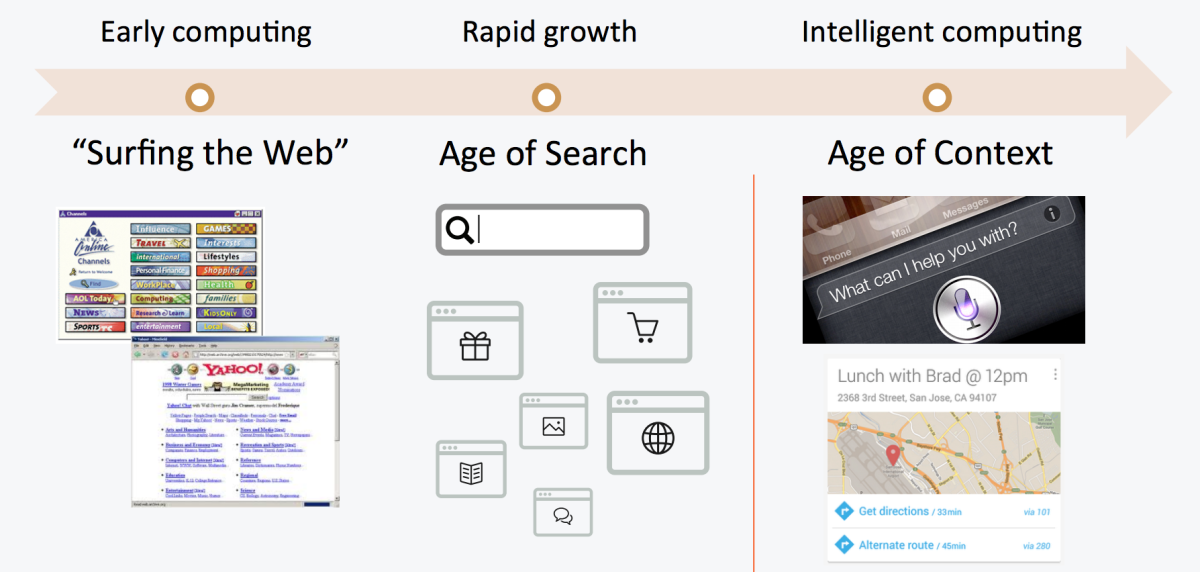
http://techcrunch.com/2015/02/26/mobile-search-david-vs-googliath/
 Pete Deutschman